
The lifo inventory method is one of the most important inventory valuation techniques used in accounting and business management. It is widely used to calculate cost of goods sold and manage financial reporting in businesses dealing with changing prices.
The lifo inventory method helps businesses determine how recent purchase costs are applied to sales, especially in inflationary conditions where prices keep increasing. Inventory management is a key part of running a successful business.
Whether you operate a retail store, warehouse, or manufacturing unit, how you value your stock directly affects your profits, taxes, and financial reporting. The lifo inventory method plays a major role in cost calculation and financial decision-making.
In this guide, we will explain everything about LIFO in simple language, including examples, formula, advantages, and real-world usage.
What is LIFO Inventory method in accounting?
The lifo inventory method (Last In, First Out) is an accounting system where the most recently purchased or produced goods are assumed to be sold first. This means the latest stock added to inventory is used for sales before older stock.
Under this method, older inventory remains in storage and is recorded as ending stock on the balance sheet. It is mainly used to calculate the cost of goods sold (COGS) and determine profitability.
In simple terms, the lifo inventory method assumes that “new stock goes out first, old stock stays behind.”
This method is commonly used in industries where prices fluctuate frequently, especially during inflation.
How LIFO Inventory Method Works
To understand how the lifo inventory method works, imagine inventory as layers stacked on top of each other.
- New stock is added on top
- Old stock stays at the bottom
- When sales happen, the top layer (new stock) is used first
This system ensures that the latest purchase prices are used in cost calculations.
So in practice:
- Cost of goods sold reflects recent prices
- Remaining inventory reflects older, cheaper costs
This makes the lifo inventory method especially useful during rising prices, as it better matches current expenses with current revenue.
LIFO Method with Example (Step-by-Step)
Let’s look at a LIFO accounting method example with solution:
Scenario:
A business purchases inventory:
- 100 units at ₹10
- 100 units at ₹12
Now, the business sells 150 units.
Step-by-Step Calculation:
- Sell latest 100 units → ₹12 × 100 = ₹1,200
- Sell remaining 50 units → ₹10 × 50 = ₹500
Total COGS:
₹1,700
Remaining Inventory:
- 50 units at ₹10 = ₹500
This LIFO example clearly shows how recent costs are used first.
LIFO Formula
The LIFO formula is used to calculate cost:
COGS = Cost of Latest Inventory Purchased First
In simple terms:
- Identify the latest inventory
- Apply those costs first to sales
This method plays a key role in inventory accounting techniques.
LIFO in Accounting and Financial Reporting
LIFO in accounting is mainly used to:
- Calculate cost of goods sold
- Value remaining inventory
- Prepare financial statements
Role in Financial Reporting:
- Reduces reported profit during inflation
- Lowers taxable income
- Shows conservative financial results
This is why many businesses consider it among important accounting methods for inventory.
Advantages of LIFO Inventory Method
The lifo inventory method offers several advantages for businesses:
- Helps reduce taxable income during inflation
- Matches current costs with current revenues
- Improves cash flow management
- Protects profit margins in rising price markets
- Useful for industries with fluctuating raw material prices
These benefits make it a strategic choice for businesses dealing with constant price changes.
Why Businesses Choose the LIFO Method
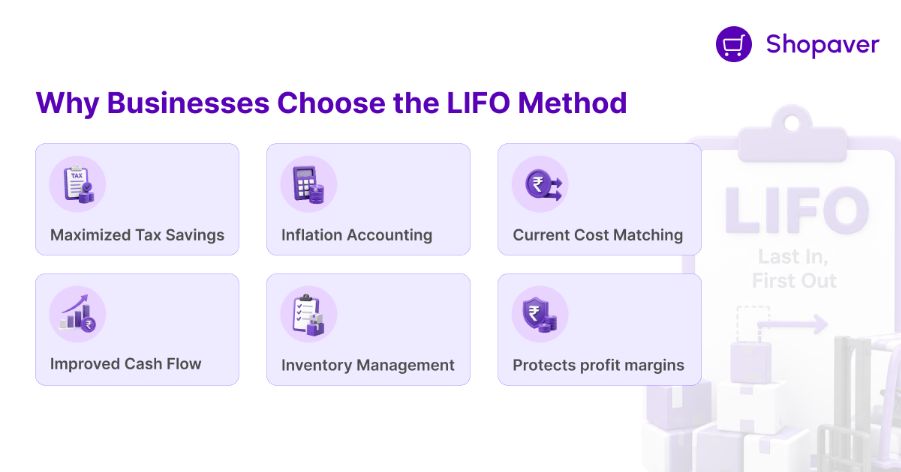
- Improved Cash Flow
- Optimized Inflation Accounting
- Matches current costs with revenue
- Protects profit margins
Benefits of LIFO Method for Businesses
The benefits of LIFO method for businesses include:
- Financial efficiency during inflation
- Improved liquidity
- Better expense matching
- Strategic tax planning
This makes it useful as a LIFO inventory method for small business in certain industries.
Impact of LIFO on Financial Statements
The impact of LIFO on financial statements is significant:
1. Profit
- Lower profits due to higher COGS
2. Tax
- Reduced tax liability
3. Inventory Value
- Lower closing inventory value
Overall, it presents a conservative financial picture.
Real-World Use Cases of LIFO Inventory System
The LIFO inventory system is used in:
- Manufacturing industries (raw materials)
- Oil and gas sector
- Metal and commodity businesses
- Non-perishable goods warehouses
It works best where prices fluctuate frequently.
When to Use LIFO Inventory Method
You should consider when to use LIFO inventory method in these situations:
- Rising prices (inflation)
- Non-perishable inventory
- Large inventory volumes
- Focus on tax savings
The LIFO inventory system is a smart accounting and billing technique that helps businesses manage inventory costs during inflation. By treating the latest inventory as the first sold, it ensures better matching of current costs with current revenues, making billing and financial reporting more accurate.
LIFO sells latest inventory first, reducing taxes during inflation but lowering profits. FIFO sells oldest inventory first, showing higher profits and inventory value while matching older costs with current sales.
This method is especially useful for businesses that handle frequent billing transactions and large inventory volumes, as it helps maintain updated cost calculations in invoices and sales records.
While it helps reduce taxes and improve cash flow, it also lowers reported profits and inventory value. Therefore, businesses must carefully evaluate whether this method fits their financial and billing strategy.
In short, the LIFO inventory method is a useful tool for inventory control, billing management, and cost optimization, but it should be used strategically based on industry needs and accounting regulations.
FAQs
Q1. What is LIFO in accounting?
Ans- LIFO (Last In, First Out) is an inventory valuation method where the most recently purchased items are sold first.
Q2. How does LIFO inventory method work?
Ans- It works by assigning the cost of the latest inventory purchases to the cost of goods sold, while older inventory remains in stock.
Q3. Is LIFO allowed in India?
Ans- No, LIFO is not allowed under Indian accounting standards (Ind AS/IFRS), but it may be used in some other countries like the United States.

Narendra Kumar is a skilled content writer crafting engaging and insightful content.